What drives the price of 3D rendering and product animation — and how to write a brief so the quote matches your budget. Real ranges, no sales talk.
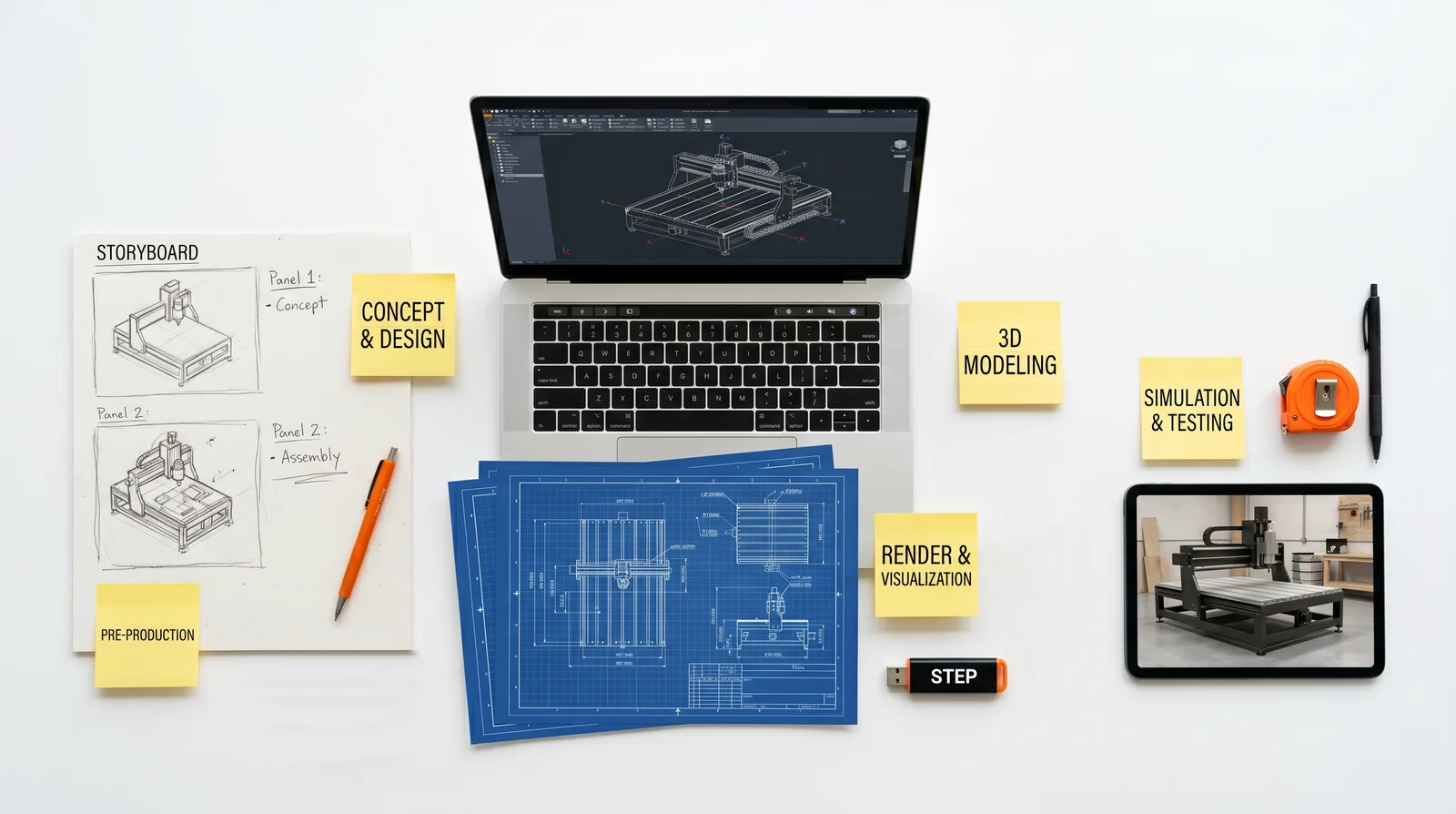
There's a moment every marketing manager at a CNC or medical device company knows: you send an RFQ to three 3D studios and get back quotes of €600, €1,400, and €4,000 — for what looks like the same deliverable. Either the market is broken or the brief was unclear. Usually, it's the brief.
3D visualization doesn't have a menu price the way a logo design or a stock photo does. It's closer to how a custom CNC part is priced: the geometry, tolerances, and material define the cost, not the finished object. This guide shows you exactly how that logic works.
There's no industry menu price for 3D visualization — it's closer to how a custom CNC part is priced: geometry, tolerances, and source material define the cost, not the finished object. As a rough orientation: simple product renders start from a few hundred euros per image, short animations from a few thousand, and complex industrial explainer animations from ten thousand and up. The two axes that determine where any given project lands are what type of deliverable you need and how complex your product is.
Eastern European studio advantage: For the same quality tier, Warsaw-based studios typically quote 30–45% below comparable studios in Germany, the UK, or the US. Poland has a mature 3D industry with studios that have worked on iF Design Award projects. You get Western European quality at Central European rates.
Most people assume cost scales with how "fancy" the final image looks. It doesn't. Cost scales with production time, driven by five factors in order of importance.
Understanding these will let you read any quote intelligently — and write a brief that gives the studio less to guess at.
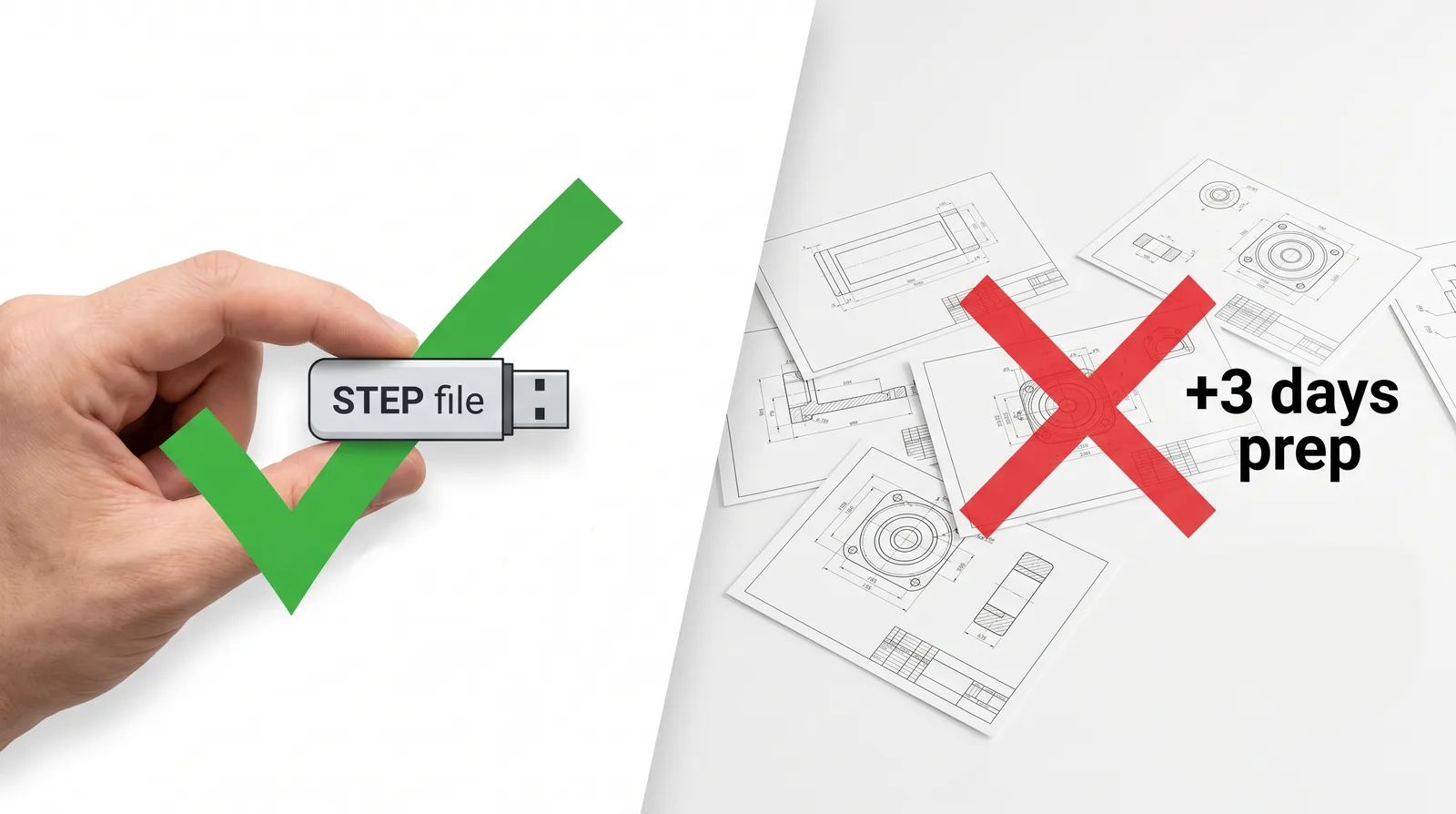
A clean STEP file cuts modeling time by up to 40% on complex industrial products — the single biggest lever for reducing your quote.
After 17+ years running Modelight, I've seen every shape of quote — including the ones that end badly. Here's what to watch for:
The single biggest driver of quote accuracy — and therefore quote efficiency — is how much useful information you provide upfront. The more context and materials you give a studio, the less time they spend estimating in the dark, and the tighter (and usually lower) the resulting quote. Five things make the biggest difference:
Want a realistic quote for your project? Send us your product brief and CAD files (if available), and you'll get an itemized estimate within 24 hours. No sales calls required. Get a quote →
The honest answer, after nearly two decades: for industrial manufacturing, medical devices, HVAC equipment, and CNC machinery — 3D visualization usually pays back within a single sales cycle.
Not because renders look nice. Because a B2B decision-maker will not fly to your factory to see a prototype during an RFQ evaluation. They will, however, spend 90 seconds watching a well-constructed 3D animation that shows exactly how your machine works. Forrester research has consistently shown that 70%+ of B2B purchase decisions are made before the buyer contacts a sales rep.
We've seen clients close high-value CNC equipment deals with a single short explainer that cost a fraction of one unit's margin to produce. Not every project works out that way — but the economics of 3D in B2B industrial sales are genuinely favorable when the product is complex enough to be hard to explain in photos.
For a single B2B product render, entry-level scope covers simple products with plain backgrounds. Detailed industrial products with styled scenes sit in a mid range. Complex machinery renders with custom environments represent the upper end per image. The first image in a project always includes modeling cost — subsequent images from the same model are significantly cheaper.
A 30-second B2B 3D product animation spans a wide range depending on product complexity and animation depth. Simple rotating loops with a plain studio background sit at the lower end. Explainer animations with cross-sections, labels, and voiceover are significantly higher. Industrial machine animations with multiple moving assemblies and environment represent the largest scope. Use our calculator for a ballpark, or send us a brief for an itemized estimate.
Yes, significantly. Clean CAD files (STEP, IGES, SolidWorks, Inventor, Creo) can cut modeling time by up to 40% for complex mechanical products. For a CNC machine or medical device, that translates to saving days of a 3D artist's time — which shows directly in the quote. The overall project reduction depends on product complexity, but for industrial projects it's typically the single most impactful thing a client can provide.
Three reasons: studio location (Eastern European studios are typically 30–50% cheaper than US or Western European studios with similar quality), specialization (an industrial-focused studio prices CNC differently than a generalist), and scope assumptions (some studios quote render-only; others include modeling, revisions, and rights).
Most professional studios include 2–3 rounds of revisions at the low-res preview stage, when changes are cheap. Revisions after final rendering are billed separately because they require re-rendering the entire frame. Always agree on revision rounds in writing before work starts.
Send a brief description and CAD files if you have them. Itemized estimate back within 24 hours.
Get a quote