Why industrial manufacturers, medical device companies, and CNC equipment brands are replacing PDFs and photography with 3D — and what the conversion data actually looks like.
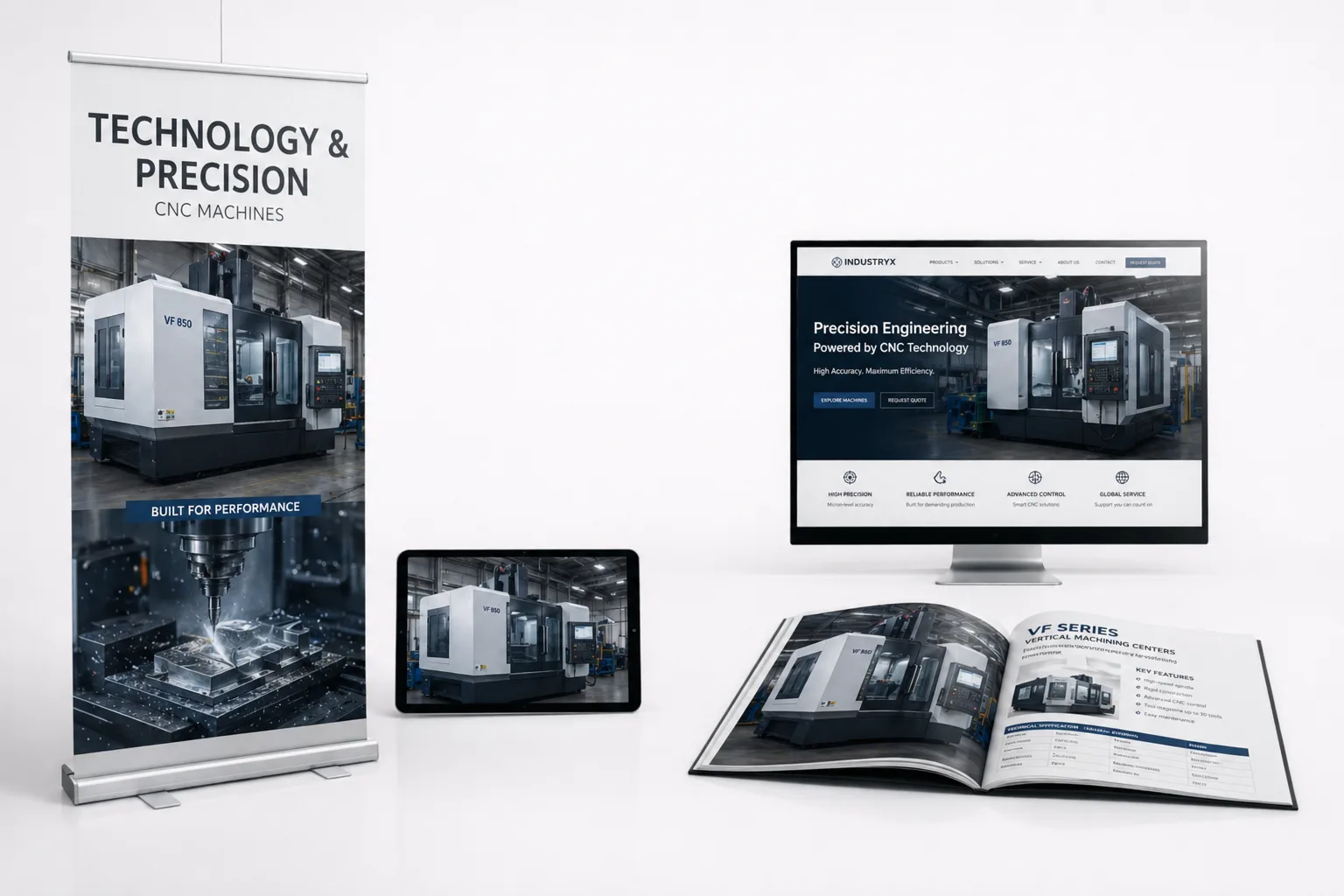
There's a conversation I've had variations of dozens of times with industrial marketing managers: they've spent €5,000 on a photo shoot of their new CNC machining center, the images look great, and yet the product page converts worse than the previous generation's page. "The photos are objectively better," they tell me. "Why isn't anything working?"
Here's the short answer: a photograph of a complex machine tells a buyer almost nothing about why it's better than the last model. A photo shows surface. Industrial B2B buyers are evaluating depth — how the machine works, what's inside it, how it compares. Photography was designed for products whose value is visible. Industrial products rarely qualify.
These aren't my numbers — they're industry benchmarks consistently reported across Forrester, Gartner, and vendor-led studies of B2B manufacturing marketing. The pattern is stable: wherever a product is complex enough that buyers need to understand it (not just see it), 3D content outperforms flat content on every measurable axis.
Product photography is optimized for a specific kind of buyer question: "What does this look like?" It answers that question extremely well. But in industrial B2B, that's almost never the buyer's actual question. The questions that drive industrial purchasing decisions are:
3D content pays back best at three specific points in the B2B industrial sales process. The economics look different at each.
Not every product justifies 3D marketing investment. The key variable is unit value — specifically, how many incremental deals 3D needs to generate in a year to pay for itself. For high-ticket industrial products, the math closes fast. For lower-ticket consumables, shared assets across a product family usually make the numbers work.
The clients who get the most from 3D treat it as a reusable asset library, not as one-off deliverables. A fully developed 3D marketing system for a single industrial product typically includes:
The total scope and investment for a complete 3D asset package depends on product complexity, number of variants, and the asset types required. For manufacturers selling high-ticket equipment, the cost of a full 3D content system is typically well below the margin on a single incremental deal — which is why the economics close quickly for complex industrial products.
Thinking about a 3D marketing rollout? We can scope a full asset package for your flagship product — renders, animation, technical documentation, and optional configurator. Get a scoping proposal →
3D marketing works when the underlying product, pricing, and positioning are already reasonable. It amplifies; it doesn't create demand from nothing. If your product genuinely isn't competitive, a beautiful animation won't close deals. If your website has usability problems, a hero animation won't fix bounce rate.
The industrial manufacturers who get the biggest returns from 3D are usually the ones who already had clear positioning, competitive products, and a functioning sales process. 3D makes their existing story land harder. For manufacturers without those foundations, we usually recommend fixing the foundations first.
Yes — with measurable impact in industrial sales. Industry research consistently shows 3D content generates 3× more engagement than flat images, 20%+ higher conversion on product pages, and up to 40% shorter sales cycles on complex machinery. The effect is strongest for products that are hard to understand from photos alone — CNC equipment, medical devices, HVAC systems.
3D adds most value at three points: (1) website product pages — where a hero animation replaces static photography and keeps visitors on the page 2–3× longer; (2) sales enablement — where a 60-second explainer replaces a 20-slide PDF in first meetings; (3) trade shows — where 3D cross-sections and process animations outperform live demos on crowded booth floors.
For small manufacturers selling high-ticket products (anything above €25,000 per unit), a single closed deal usually pays back the animation cost 5–20 times over. For lower-ticket industrial products, 3D makes more sense as a shared asset across product lines — one hero animation plus variations for a product family is more economical than one-off animations per SKU.
Product photography shows what a product looks like. 3D shows how it works. For industrial, technical, or medical products where the value lies in internal mechanisms, operational processes, or engineering details, 3D is frequently the only way to communicate value without a live demonstration.
Send us your product details. We'll tell you honestly whether 3D makes economic sense — and scope a realistic proposal if it does.
Request a scoping call